
Mehr Center report — 26 March 2026
Three months after nationwide protests began in Iran on 28 December 2025, the full human cost of the authorities’ response is still emerging. Mehr Center has reviewed the information now available, including the findings of United Nations human rights mechanisms, official Iranian statements and witness accounts. The evidence indicates that thousands of people were killed, tens of thousands were arrested, and a growing number of detainees face the death penalty. This report sets out what is known so far, the gaps that remain, and our recommendations.
Background
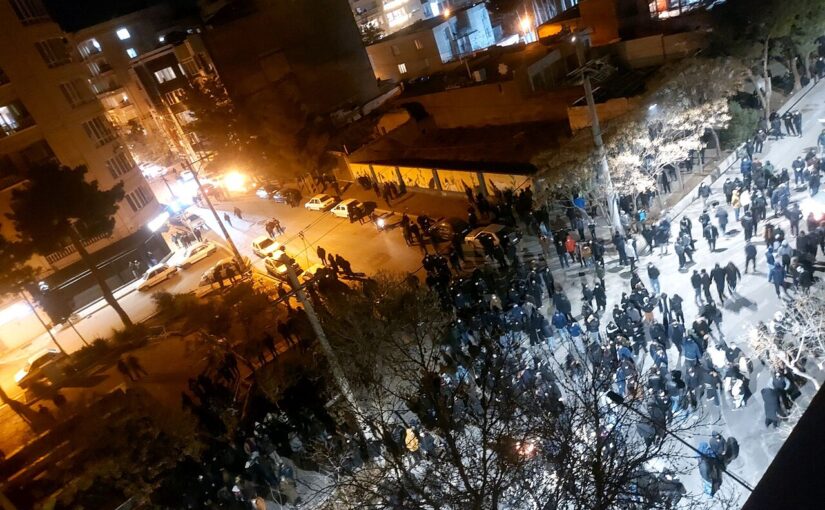
The protests began on 28 December 2025 and, according to the UN Independent International Fact-Finding Mission on Iran, quickly spread to all 31 provinces. Demands that began with economic grievances soon broadened into calls for fundamental rights and political change, and protests took place in hundreds of locations in cities and towns across the country.
The Fact-Finding Mission reports that, while the government initially adopted a conciliatory tone, its response “quickly descended into increasing violence.” Security forces reportedly shot and killed protesters from around 31 December 2025. Between 31 December and 3 January, at least 28 protesters and bystanders, including children, were reported killed across eight provinces.
The communications shutdown and the killings of 8–10 January
On the evening of 8 January 2026, the authorities imposed a total shutdown of internet, mobile and landline communications across the country. The Fact-Finding Mission found that “a marked escalation in violence and deaths began shortly thereafter, as millions of people took to the streets,” and that the shutdown concealed this escalation. On 9 January, the Supreme National Security Council reportedly ordered security forces to end the protests decisively.
The available evidence indicates that the great majority of deaths occurred in the days immediately after the shutdown began. The Fact-Finding Mission received witness accounts from Alborz, Gilan, Ilam, Isfahan, Kermanshah, Kurdistan, Lorestan, Mazandaran and Tehran provinces describing:
- security forces firing on crowds with shotguns, assault rifles and heavy machine guns, and reports of snipers;
- bodies left in the streets of Karaj, Isfahan and Tehran, and injured protesters reportedly shot again in Karaj;
- widespread injuries to the face and eyes from metal pellets. One source told the Mission that doctors at a hospital in Isfahan had to remove the eyes of some 450 injured protesters;
- more than 200 injured people arriving at a single Tehran hospital within one hour on the evening of 8 January;
- attacks on medical care: on 4 January, security forces reportedly raided a hospital in Ilam and beat injured protesters and medical staff, and there are reports that medical workers were later arrested for treating the wounded.
From 11 January, footage from the Kahrizak forensic centre south of Tehran showed families searching for relatives among what appeared to be hundreds of body bags.
The Mission also noted reports of violence by some protesters, including the burning of vehicles and damage to mosques, banks and government buildings. Such acts do not justify the use of lethal force against crowds. Under international law, firearms may be used only as a last resort against an imminent threat to life.
How many people were killed?
A precise death toll cannot yet be established. The Fact-Finding Mission says that the scale of casualties, the communications blackout and the government’s refusal to grant access have made precise estimates impossible, but that people were “killed and injured on a staggering scale.” The figures available are:
| Source | Reported deaths |
|---|---|
| Iranian authorities (Foundation of Martyrs and Veterans Affairs, 21 January) | 3,117 |
| UN Fact-Finding Mission, citing a credible human rights organization (report of March 2026) | Over 7,000, including up to 6,500 protesters, over 230 children and at least 200 members of the security forces |
| UN Special Rapporteur on Iran (report of 16 March 2026) | At least 7,015 confirmed by 15 February, with a further 11,744 deaths still under review |
These figures represent only the cases that could be verified despite the communications blackout. Higher estimates have been reported but have not been independently confirmed. Taken together, the available evidence indicates that the true number of deaths is several times higher than the official figure.
Families of the victims
The Fact-Finding Mission received credible information that bereaved families have been barred from holding funerals or have faced severe restrictions, and that some were required to pay large sums to recover the bodies of their relatives. Witnesses said that families were threatened that their relatives would be buried in unknown locations unless they stayed silent about the cause of death, and that some were pressured to state falsely that the person killed had been a member of the Basij.
Mass arrests
On 16 January, state-affiliated media announced that thousands of people had been arrested. According to information reported by the UN Fact-Finding Mission, more than 50,000 people had been arrested by mid-February, including women, university students, schoolchildren, human rights defenders, lawyers, journalists and members of minority communities. State media have also broadcast forced confessions by detainees. On 17 February, the judiciary stated that 10,538 people had been referred for prosecution and more than 8,800 indictments issued. Allegations of torture and gender-based violence against detainees, including children, have also emerged.
Death sentences and the first executions
On 10 January, the Prosecutor General declared that protesters had committed moharebeh (“enmity against God”), a charge that carries the death penalty. The Head of the Judiciary instructed courts to act quickly and to show no leniency. The UN Special Rapporteur on Iran, Mai Sato, reported on 16 March that at least 30 people, including two 17-year-olds, were reportedly facing the death penalty after expedited proceedings.
On 19 March 2026, the authorities executed the first protesters in connection with these events. Saleh Mohammadi, Mehdi Ghasemi and Saeed Davoudi were hanged in Qom after being convicted of involvement in the killing of two police officers on 8 January. Saleh Mohammadi, a member of Iran’s national wrestling team, had reportedly just turned 19. Human rights organisations report that the three men were denied effective access to independent lawyers and were convicted on the basis of confessions allegedly obtained under torture, after fast-tracked proceedings.
We are deeply concerned that further executions may follow. Executions carried out after unfair trials violate the right to life under international law.
The international response
In January, the UN Human Rights Council held a special session on Iran and adopted a resolution extending the mandates of the Fact-Finding Mission and the Special Rapporteur, and calling for an urgent investigation into violations committed in the context of the protests. Iran rejected the resolution.
In its report to the Council’s current session, the Fact-Finding Mission found credible allegations that “gross human rights violations and crimes under international law may have occurred,” describing “unprecedented levels of violence not seen since the revolution of 1979.” It concluded that the alleged violations “do not appear sporadic, but rather widespread, and carried out in an organized manner.” Its investigations are ongoing.
The Mission has also warned that the human rights situation has been severely worsened by the military strikes on Iran that began on 28 February 2026. Iran’s population is now caught between armed conflict and a government that has only just ended a violent crackdown.
Our recommendations
To the authorities of the Islamic Republic of Iran:
- Do not carry out any more executions. Halt all executions, quash every death sentence issued in connection with the protests, and move towards abolishing the death penalty;
- Do not use lethal force against protesters. Respect the right of people to gather and protest peacefully and to express their views freely;
- Release everyone detained for peaceful protest, and guarantee fair trials, free of coerced confessions and with lawyers of the defendants’ choosing, for anyone still charged;
- Begin a genuine national dialogue and process of reconciliation with the people of Iran: listen to their grievances, acknowledge the victims, and make peace with the country’s own citizens;
- Tell families the truth about their loved ones, return bodies without conditions, and end all pressure on bereaved families;
- Allow independent investigation of the allegations of torture and ill-treatment, through fair processes and never through the death penalty;
- Grant the UN Fact-Finding Mission and the Special Rapporteur access to the country.
To the international community:
- Urge the Iranian authorities, publicly and privately, not to carry out executions and to allow peaceful protest;
- Support peaceful solutions: encourage dialogue between the Iranian authorities and the people of Iran, an end to armed conflict, and an end to violence by all sides;
- Support the UN Fact-Finding Mission and the Special Rapporteur in establishing the truth for victims and their families;
- Provide protection, humanitarian visas and medical and psychosocial support to people fleeing persecution, as urged by the Fact-Finding Mission;
- Take all possible steps to protect Iran’s civilian population, whose rights are now threatened by both repression and armed conflict.
Mehr Center will continue to document these events and to stand with the victims and their families.
Sources
- UN Independent International Fact-Finding Mission on the Islamic Republic of Iran, Report to the Human Rights Council, A/HRC/61/60 (March 2026)
- UN Special Rapporteur on the situation of human rights in the Islamic Republic of Iran, report to the 61st session of the Human Rights Council (presented 16 March 2026)
- Al Jazeera, At least 3,117 people killed during Iran protests, state media report (21 January 2026)
- CBS News / AFP, Iran hangs 3 people, including teen wrestler, in first executions over January protests (19 March 2026)
- Amnesty International, Internet shutdown hides violations in escalating deadly crackdown on protesters (January 2026)
